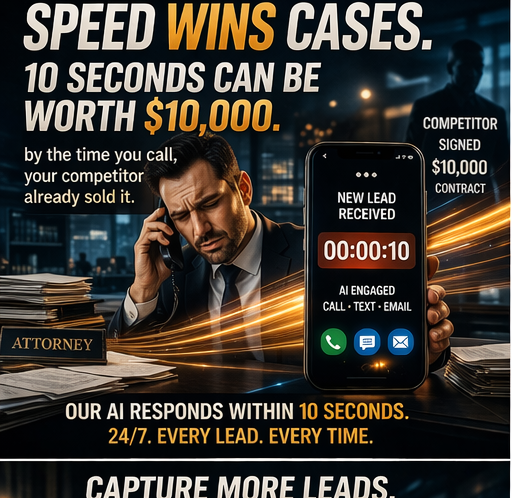
Overview
You spend hours worrying about the firm across town. They have better reviews. They have a bigger marketing budget. They've been around longer. They're stealing your clients. But they're not your real competition. Your real competition is the clock.
The Response Time Crisis
Here's the reality of legal lead generation in 2026: When someone searches "personal injury lawyer" and fills out a contact form, they don't fill out one form. They fill out three to five. Sometimes more. They're in pain, they're scared, and they're hedging their bets. The first firm to respond — to actually engage in a real conversation about their case — wins. Not 50% of the time. Not 60% of the time. 78% of the time, the first responder gets the client. That means your $300-per-click Google Ads budget, your beautiful website, your years of experience, your five-star reviews — all of it becomes irrelevant if another firm calls them first.
How Slow Is Your Firm, Really?
Most managing partners think their response time is "pretty fast." Let's test that. Pull up your CRM right now. Look at the last 20 web leads. Check the timestamp on the form submission. Check the timestamp on the first outreach attempt. Calculate the gap. If you're like most firms I talk to, that gap is somewhere between 30 minutes and 4 hours during business hours. After hours? It's 12-16 hours. Weekends? 48 hours. Long weekends? Don't even ask. Now ask yourself: how many of those 20 leads had already talked to another firm by the time you called?
Why Humans Can't Win the Speed Race
Your intake coordinator is on a call. A new lead comes in. They can't answer it immediately because they're already talking to someone. The lead waits 8 minutes. Or 15. Or 30. Your intake coordinator goes to lunch. Three leads come in. They sit for an hour. Your intake coordinator goes home at 5pm. Between 5pm and 9am, 15 leads come in. They all wait until morning. This isn't a bad intake coordinator. This is every intake coordinator. Human beings can only do one thing at a time. They need breaks. They go home. They get sick. The math is unbeatable: humans cannot consistently respond to every lead within 5 seconds, 24 hours a day, 365 days a year. AI can.
The Compound Cost of Slow Response
Let's quantify what slow response actually costs your firm: 100 leads per month at $200 per lead = $20,000 in marketing spend. At industry-average response times (30+ minutes), you lose roughly 30-40% of leads to faster competitors. That's 30-40 leads per month, at $200 each, that you paid for but someone else converted. Cost of slow response: $6,000-$8,000/month in wasted marketing spend. $72,000-$96,000/year. And that's just the marketing waste. The lost case revenue is multiples higher.
Making Response Time Your Competitive Advantage
Instead of competing on brand, budget, or experience — compete on speed. It's the one thing you can win at overnight by deploying AI. When every lead gets a call, text, and email within 5 seconds — and a real, intelligent conversation about their case — you become the firm that always responds first. Not sometimes. Not during business hours. Always. Over time, this creates a compounding advantage: - Higher conversion rates from the same spend - Lower cost per acquisition - Better reviews (clients remember the firm that showed up fast) - More referrals - Higher attorney utilization (more consultations, more signed cases)
The Simple Question
If you knew — with absolute certainty — that responding 5 seconds faster would sign you 30-40% more clients, what would you pay for that? Now compare that number to what AI intake actually costs. The ROI isn't close. Response time is the race. AI is how you win it. See your firm's speed-to-lead score — book a free assessment today.