Overview
Your average response time to a new lead is 4-6 hours. I know you don't believe that because you told your team to "get to leads within 15 minutes." But pull the actual data from your CRM. Look at timestamp of lead arrival vs. timestamp of first outreach. 4-6 hours is the industry average. Some companies are worse. A few are better. But almost nobody is under 5 minutes consistently. Now look at what happens in those 4-6 hours: Minute 1: Lead fills out form. They're anxious, motivated, phone in hand. Minute 5: Still waiting. Starting to cool off. Opening another tab. Minute 15: Filled out a second form. Another company's lead now too. Minute 30: Getting distracted. Kids need attention. Dinner's ready. Hour 1: Forgot they submitted the form. Phone's on the charger in the other room. Hour 2: Competitor #1 calls. Lead answers because they're still somewhat expecting a call. Competitor has a conversation. Books an enrollment appointment. Hour 4: YOU call. Lead doesn't recognize the number. Ignores it. Or picks up and says "I already talked to someone about this." The lead cost you $40. The competitor paid $40 for the same lead. They enrolled the client. You got a voicemail.
5 Seconds Changes Everything
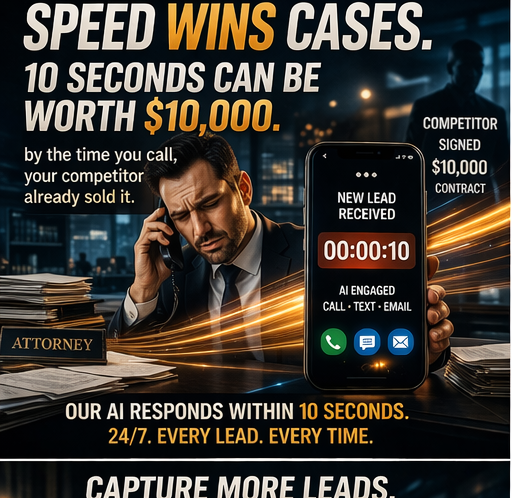
When AI handles your speed-to-lead, the timeline changes: Second 0: Lead fills out form. Second 5: Phone rings. Text arrives. Email lands. All three. Simultaneously. The lead is still sitting there. Still anxious. Still motivated. Still holding their phone. And YOUR company just showed up. "Hi, I see you reached out about getting help with your debt. Great timing -- I can look into your options right now. Do you have about 5 minutes?" That's it. Game over. You won. Not because your program is better. Not because your fees are lower. Because you showed up first.
The Data on Response Time in Debt
The research on speed-to-lead is well-established across industries, but in debt it's even more pronounced because of the emotional nature of the decision. - Leads contacted in under 1 minute: 391% higher contact rate - Leads contacted in under 5 minutes: 21x higher qualification rate vs. 30-minute response - After 5 minutes: Contact rate drops by 10x - After 30 minutes: You might as well throw the lead in the trash In debt specifically, the first company to call enrolls the client 78% of the time. Not 50%. Not 60%. Seventy-eight percent. Why? Because debt decisions are emotional. The person is in pain RIGHT NOW. The first company that shows up with a solution captures that emotional energy. By the time the second company calls, the person is either already committed or has emotionally regulated and isn't ready to act anymore.
Why Your Team Will Never Be Fast Enough
You can set all the alerts you want. Ping Slack. Flash the screen. Set a 3-minute SLA. Your team will still average 15-45 minutes on a good day because: - They're on other calls - They're in the bathroom - They're at lunch - They're in a meeting - They're updating CRM from the last call - They're on a break - It's 9 PM and nobody's working Human speed-to-lead has a ceiling. And that ceiling is nowhere near 5 seconds. AI doesn't have a ceiling. 5 seconds. Every lead. Every time. 24/7/365. It doesn't matter if it's 2 AM on Christmas or 10 AM on a Monday. The response time is identical.
The Compounding Advantage
Speed-to-lead isn't just about winning one lead. It's about winning a PERCENTAGE of every lead, every day, forever. If you contact 10% more leads first (because you're 5 seconds vs. their 4 hours), and first-contact wins 78% of enrollments, you're adding roughly 8% to your total enrollment rate. On 1,000 leads per month, that's 80 additional enrollments. Per month. Every month. That's not a one-time benefit. It compounds. Over a year, 960 additional enrollments that your competitors would have gotten instead. 5 seconds vs. 4 hours. It's not even close. Make sure you're the 5 seconds. [See it in real-time. We'll trigger a test lead and you can watch AI respond in 5 seconds flat. Book a demo.]