5 Seconds. That's Your Window.
Here's a stat that should make you want to throw your phone across the room: the first company to call a solar lead has a 78% higher chance of closing that deal. Not 10%. Not 20%. Seventy-eight percent. And yet — go ahead, fill out a solar form on Facebook right now. Time how long it takes for someone to call you back. If you get a call within 5 minutes, you hit the jackpot. Most companies? 30 minutes. An hour. Some don't call until the next day. A few never call at all. Meanwhile, the homeowner who just spent 45 seconds filling out that form is already Googling "solar companies near me" and filling out three more forms. By the time your rep gets around to calling, they've already talked to two competitors and made an appointment with the one who called first. That's not a sales problem. That's a math problem. And you're losing.
Why Speed to Lead Matters More in Solar Than Almost Any Other Industry
Solar is a considered purchase. Nobody wakes up and impulse-buys a $30,000 solar system. But there IS a moment — a trigger — when a homeowner goes from "I've been thinking about it" to "I'm ready to talk to someone." Maybe their electric bill hit $400 this month. Maybe their neighbor just got panels installed and won't shut up about their $0 bill. Maybe they saw an ad on Facebook that said "no money down." Whatever the trigger, it created urgency. And that urgency has a half-life shorter than a TikTok trend. Every minute you don't call, the urgency fades. Every hour, it drops by half. By tomorrow? They're back to "thinking about it" — and they're not thinking about you.
The 5-Second Play
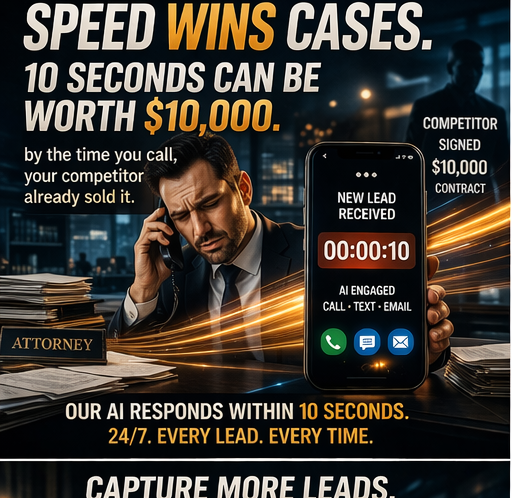
When we set up AI for solar companies, the first thing we configure is the 5-second response. Here's what happens the INSTANT a lead comes in: 1. Phone call initiated — AI calls the lead within 5 seconds 2. Text message sent — "Hey [Name], thanks for your interest in solar! We're calling you now." 3. Email fired — confirmation with company info, reviews, what to expect All three. Five seconds. Simultaneously. If the lead picks up the phone, the AI handles the initial qualification — confirms they're the homeowner, roof type, electric bill range — and either books an appointment or warm-transfers to a rep. If they don't pick up? The sequence continues. Text follow-up at 5 minutes. Another call at 15 minutes. Text at 1 hour. Call at 3 hours. And so on for 30 days. No human involved until there's a qualified, ready-to-talk homeowner on the line.
"But We Already Have a Speed-to-Lead Process"
I hear this a lot. Usually followed by "our reps are supposed to call within 5 minutes." Cool. Now let me ask you: - What happens when a lead comes in at 6:47 PM and your reps are at dinner? - What happens when 15 leads come in simultaneously during a Facebook ad spike? - What happens on Saturday afternoon when your top setter is at their kid's baseball game? - What happens when your rep is on a call with another lead and three more come in? The answer to all of these is the same: those leads wait. And while they wait, they're getting calls from the companies that don't have this problem because they automated it. AI doesn't eat dinner. AI doesn't go to baseball games. AI doesn't get overwhelmed by volume spikes. AI responds in 5 seconds at 2 AM on Christmas Day.
The Real Cost of Being Second
Let's do the math. You're spending $80 per solar lead. You buy 1,000 leads a month — $80,000. Industry data says 50% of leads go to the vendor that responds first. If your speed to lead is 30 minutes, and your competitors are at 5 seconds, you're losing roughly half your leads before your reps even pick up the phone. That's $40,000 in leads — gone. Every month. Not because the leads were bad. Because you were slow. Over a year, that's $480,000 in wasted lead spend. And that's before you factor in the lost revenue from the deals those leads would have become. One solar company we work with was spending $200K a month on ads. When we implemented 5-second AI response, their appointment rate jumped 40% in the first month. Same ad spend. Same leads. Just faster.
What "Fast" Actually Looks Like
Speed to lead isn't just about the first call. It's about the entire response ecosystem: Inbound web form: Call + text + email in 5 seconds. If no answer, automated multi-channel sequence for 30 days. Facebook/Instagram lead: Same thing. API integration pulls the lead and triggers instantly. No waiting for someone to check a spreadsheet. Referral: Rep enters the lead, AI takes over follow-up and appointment setting. Rep doesn't have to think about it again until the appointment is confirmed. No-show: AI texts within 5 minutes of the missed appointment. "Hey, looks like we missed you — want to reschedule?" If no response, calls within an hour. Follows up for 14 days. Positive call drop: Dialer connected but nobody picked up on your end? AI texts immediately: "Sorry about that, we were trying to reach you about solar options for your home. Got 2 minutes to chat?" Every single scenario has a sub-5-second or sub-5-minute response. No gaps. No leads dying in limbo.
The Companies That Get This Are Winning
We've worked with solar companies that went from 15 appointments a day to 50 — without hiring a single new rep. The secret wasn't better leads. It wasn't a better pitch. It was simply being FIRST. When you're first, you set the frame. You're the company they compare everyone else to. You get first crack at their objections. You build the relationship before anyone else can. When you're second — or third, or fourth — you're playing catch-up. You're overcoming not just their objections but their loyalty to whoever they talked to first.
Make It Stupid Simple
Stop relying on humans for speed. Humans are great at selling. They're terrible at being fast and consistent. That's AI's job. The company that calls first wins the roof. It's that simple. Are you first? Or are you hoping your competitor is slower than you?